The dose is a number.
The context is the story.
How much, which formulation, for whom, and for how long? Those questions belong together.
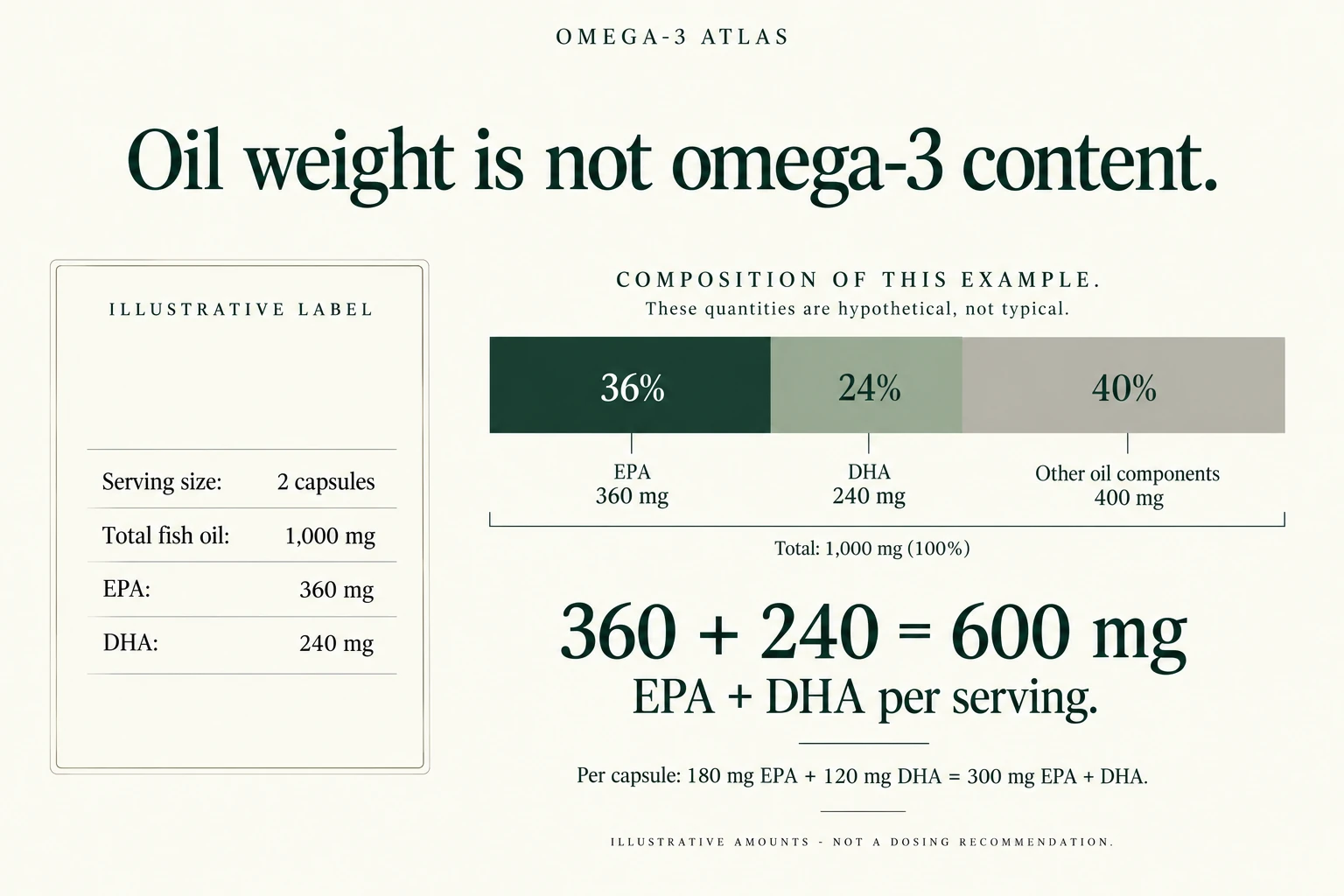
Count the right thing.
Total fish oil, EPA+DHA and prescription-product mass are different measurements.
Name the outcome.
A dose that lowers triglycerides does not automatically prevent a heart attack or improve memory.
Keep the trade-offs.
Higher doses can change both effects and adverse events. More is not automatically better.
Same nutrient family.
Different experiments.
Move the slider between seven real study examples. These are discrete study stops, not a dose-response prediction. The last two use the same labeled product dose and reached different results.
0.84 g EPA + DHA
1 g/day marine-oil capsule containing 460 mg EPA + 380 mg DHA
Who was studied?
25,871 older adults; generally primary prevention
What did they find?
No significant reduction in the primary major cardiovascular composite or invasive cancer over a median 5.3 years.
Read the original research ↗A study dose is not a recommendation. The slider combines examples with different dose definitions and outcomes; it does not compare equivalent amounts or predict your response. Prescription-dose use requires clinical context.
Why there isn’t one
universal “effective dose.”
Formulation changes the experiment
EPA-only drugs, EPA+DHA preparations, ALA-rich foods and algal oils differ. REDUCE-IT and STRENGTH both used 4 g/day of their respective products, but differed in formulation, comparator and other features. They were not a direct head-to-head trial.
Baseline diet and status can matter
Baseline intake can affect the change in omega-3 status. It does not follow that a blood test can select a dose proven to prevent every disease. Exploratory subgroup findings require confirmation.
Duration and background care matter
A short biomarker study and a multiyear cardiovascular trial answer different questions. Most prescription cardiovascular evidence comes from people also receiving medical care such as statins.
Adverse effects belong on the dose map
Some higher-dose trials show an atrial-fibrillation signal. Bleeding risk, digestive effects, medicines and personal history also belong in the discussion. Trial findings are not instructions to self-treat.
All seven study stops
0.84 g EPA + DHA · VITAL
1 g/day marine-oil capsule containing 460 mg EPA + 380 mg DHA. 25,871 older adults; generally primary prevention. No significant reduction in the primary major cardiovascular composite or invasive cancer over a median 5.3 years.
Read the study ↗1 g EPA + DHA · AREDS2
650 mg EPA + 350 mg DHA daily. Adults at high risk of progression to advanced AMD. Adding EPA/DHA did not reduce progression to advanced AMD in the primary analysis.
Read the study ↗1.5 g dietary EPA + DHA · Migraine diet trial
Diet targeted 1.5 g/day EPA+DHA; one group also reduced linoleic acid. Adults with migraine; dietary intervention. Headache frequency and severity decreased; quality of life did not significantly improve. This tested a diet, not an isolated capsule.
Read the study ↗2–3 g EPA + DHA · Blood-pressure meta-analysis
Modeled combined EPA+DHA intake range, not a single trial dose. Adults in 71 randomized trials. Small average blood-pressure reductions; the dose-response model does not establish the best dose for an individual.
Read the study ↗3 g EPA + DHA · DREAM
2 g EPA + 1 g DHA daily versus olive-oil control. Adults with moderate-to-severe dry eye; 12 months. No significant advantage in dry-eye symptom improvement over control.
Read the study ↗4 g prescription product · REDUCE-IT
4 g/day icosapent ethyl, an EPA ethyl ester prescription drug. High-risk statin-treated adults with elevated triglycerides. Primary events: 17.2% versus 22.0% over median 4.9 years. More atrial-fibrillation hospitalizations.
Read the study ↗4 g prescription product · STRENGTH
4 g/day omega-3 carboxylic-acid product containing EPA+DHA. High-risk statin-treated adults; a different formulation and comparator. Primary events: 12.0% versus 12.2%; no significant benefit. Atrial-fibrillation signal.
Read the study ↗