Life happens
at the cellular level.
A living boundary. A chemical conversation. A response that knows when to resolve. Step inside the biology of omega-3.
Begin the exploration ↓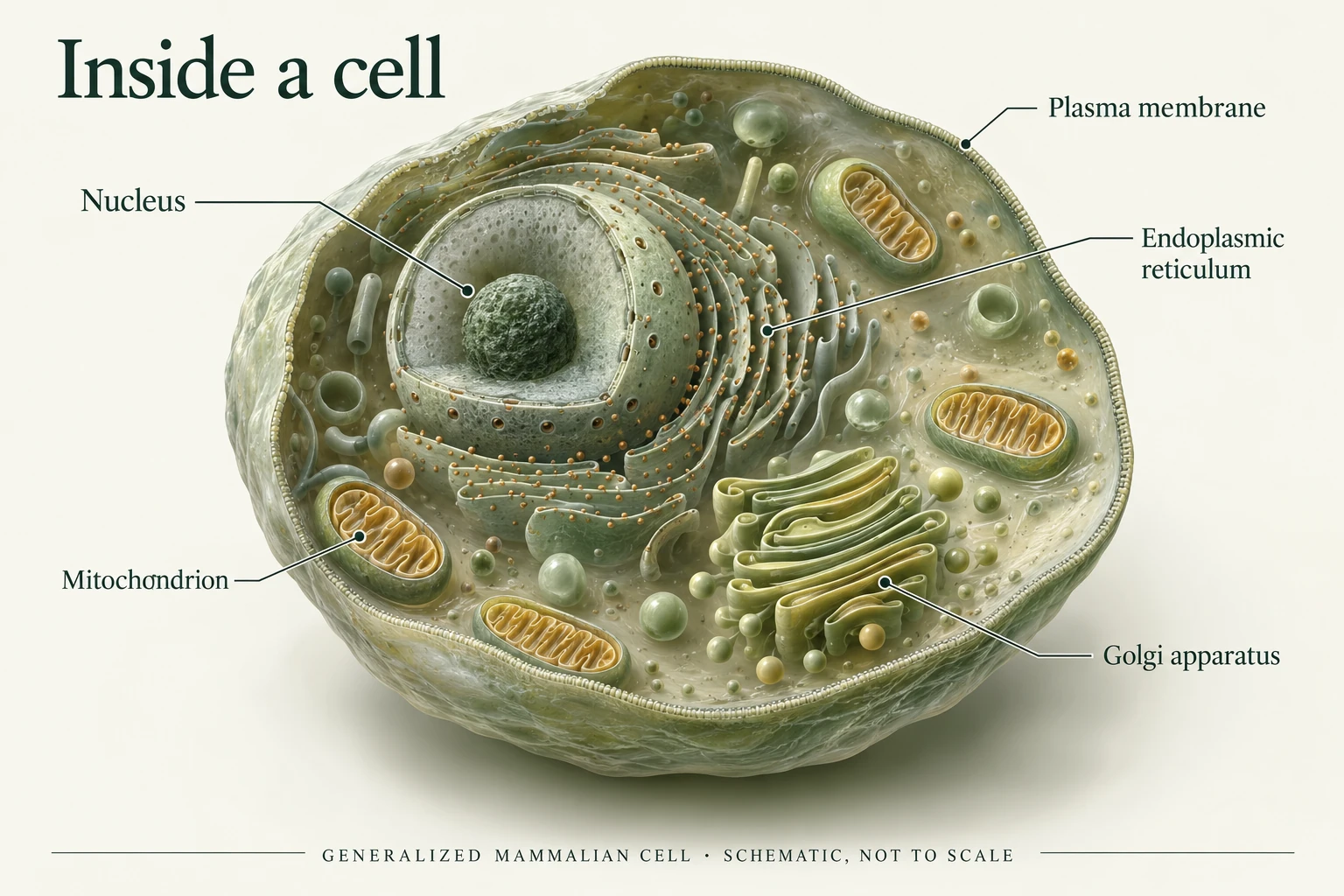
A boundary.
Built to be dynamic.
The membrane is a living interface, not a rigid shell. EPA and DHA can form part of its phospholipids, helping shape the physical environment in which membrane proteins work.
A fatty acid’s structure influences how membrane lipids behave. Cellular function depends on the whole membrane, not on a single “good” fat.
More omega-3 does not simply mean a healthier or “more flexible” cell. This diagram is a model, not a dose-response prediction.
The shape of
the conversation.
EPA and DHA belong to the same family. Their structures and biological roles overlap, but they are not identical.
Stylized visual key. Bond positions and geometry are simplified.
A precursor for lipid messages.
EPA can be incorporated into membranes and used to produce lipid mediators. It is a precursor to E-series resolvins, studied in the active resolution of inflammation.
Mechanism research helps explain possibilities. Clinical trials are still needed to establish the benefits of a particular intervention.
Read the mechanism review ↗Biology is the beginning.
Evidence is the bridge.
A compelling mechanism is a reason to investigate. Human outcomes tell us whether an intervention helps.
A biological role
How a fatty acid participates in a cell membrane or signaling pathway.
A measurable change
A change in blood fatty acids, a signaling molecule, or an inflammatory marker.
A meaningful outcome
Whether people feel better, function better, or experience fewer clinical events.
A result at one level does not automatically establish a benefit at the next.
What does
the biology tell us?
A quick thought experiment. No score. Just a clearer understanding.
DHA is abundant in brain-cell membranes. Does that prove that taking a DHA supplement improves memory?
Omega-3 biology
and human evidence.
Read the fact sheet ↗CALDER / MECHANISM REVIEWFrom membrane
to nucleus.
Read the review ↗THE ATLAS / CLINICAL CONTEXTWhat changes
for real people?
Explore the evidence ↗Conceptual illustrations, not microscopy. Cellular mechanisms are simplified for learning. Reviewed against the cited sources on September 24, 2026; formal clinical review pending.
Editorial attribution: PV Griscom, M.Sc. · Independent clinical review pending.